
Connecticut DMV Permit Practice Test 9
Test 9 of 10. Pick an answer for each question to see if it is right and why; your score appears at the end. You need 20 correct answers to pass, the same ratio as the real Connecticut test.

- Questions25
- Correct to pass20
- Passing score80%
- Minimum age16 years
-
1. What happens to the license after a third Connecticut driving-under-the-influence conviction within ten years?
Show answer
Answer D: It is permanently revoked
A third conviction inside ten years brings permanent revocation, subject only to a later request to the commissioner for relief.
-
2. In Connecticut, how long must an applicant wait before retaking a failed knowledge test?
Show answer
Answer C: Seven days
Connecticut requires a seven-day wait and a new 40 dollar fee before a failed knowledge test can be retaken.
-
3. Does Connecticut's move over law apply to an emergency vehicle that is still moving?
Show answer
Answer B: Yes, if it is traveling significantly below the posted speed limit
The duty covers emergency vehicles that are stationary and also those traveling significantly below the posted speed limit on the shoulder or in a lane.
-
4. A white regulatory sign near a state line reads BUCKLE UP IT IS THE LAW. What is it doing?
Show answer
Answer A: Reminding occupants that belt use is required
The safety belt sign restates a law that already applies, and it is usually placed where drivers enter a state or a long rural stretch.
-
5. Your lane is ending ahead in slow, heavy traffic and drivers in the next lane are already bumper to bumper. What is the recommended way to merge?
Show answer
Answer C: Take turns, one vehicle from each lane at the merge point
Alternating one for one at the merge point keeps both lanes moving and is the safest way to combine slow traffic.
-
6. You are driving in fog so thick that you can barely see the vehicle ahead. Which pavement marking is the best guide for staying in your lane?
Show answer
Answer A: The white edge line on the right side of the road
The right edge line keeps you positioned away from oncoming traffic and is easy to follow at low speed. Following tail lights closely tempts you to drive faster than you can see.
-
7. How quickly must a Connecticut license holder report a change of address to the DMV?
Show answer
Answer A: Within 48 hours
Connecticut gives license and identity card holders only 48 hours to report a new address to the commissioner.
-
8. What suspension follows a second violation of the Connecticut teen driver restrictions?
Show answer
Answer C: Six months, or until the driver turns 18, whichever is longer
The second violation costs six months or the time remaining until the driver's eighteenth birthday, whichever period is longer.
-
9. How far below the posted limit may Connecticut set a temporary variable speed limit on a limited access highway?
Show answer
Answer D: No more than 10 mph below the posted limit
A variable speed limit may not sit more than 10 miles per hour below the posted limit on that highway.
-
10. Your engine stalls while you are driving in traffic. What is the correct response?
Show answer
Answer A: Shift to neutral, try to restart it, and steer and brake toward the side of the road
With the engine off, power steering and power brake assistance fade, so steering and braking take more effort but still work. Neutral lets you attempt a restart while you coast to safety.
-
11. What happens to your field of vision as your speed increases?
Show answer
Answer C: It narrows, so you notice less at the sides of the road
The faster you travel, the more your useful field of view narrows toward the center, so a hazard coming from the side is seen late or missed altogether.
-
12. On which Connecticut roads may a low-speed vehicle be driven?
Show answer
Answer A: Any road with a posted speed limit of 25 mph or less
Low-speed vehicles are confined to highways with an established speed limit of 25 miles per hour or less, and a local traffic authority may narrow that further.
-
13. At a stop sign with a painted stop line and a crosswalk, where must you stop?
Show answer
Answer D: At the stop line, before it and before the crosswalk
You stop at the stop line first, and only if there is no stop line do you stop before the crosswalk, and only if there is neither do you stop before entering the intersection.
-
14. What does a traction control system do?
Show answer
Answer A: It limits wheel spin when you accelerate
Traction control cuts power or brakes a spinning wheel so the tires can grip when you pull away or accelerate on a slippery surface.
-
15. You are pulling out of a farm entrance onto a rural highway. What is your obligation?
Show answer
Answer C: Yield to every vehicle already on the highway before you enter the roadway
A driver entering a highway from a private road or driveway yields to every vehicle already on the highway.
-
16. You approach a one-lane bridge and there is a yield sign facing your side of it. What does that mean?
Show answer
Answer B: Oncoming traffic crosses the bridge first and you wait at the approach
At a one-lane bridge the yield sign tells one direction to give way, so you wait clear of the bridge until oncoming traffic has crossed.
-
17. How does alcohol change the time a driver needs to respond to a hazard?
Show answer
Answer A: It slows it, so stopping takes longer
Alcohol is a depressant that lengthens the time between seeing a hazard and acting on it, which adds directly to the distance needed to stop.
-
18. A pedestrian waiting at a curb faces a steady upraised hand. What does that indication mean?
Show answer
Answer A: Do not start to cross in that direction
A steady upraised hand forbids entering the crosswalk, while a flashing hand only forbids starting a new crossing.
-
19. A driver ignores this sign and passes on the opposite side. What is the main risk?
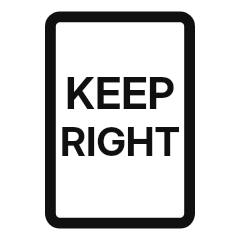
Show answer
Answer B: Ending up on the wrong side of a divider, facing traffic coming the other way
The sign settles which side of a fixed divider is the legal one, so taking the other side sends the vehicle into the opposing stream or straight at the obstruction.
-
20. Within what distance of a vehicle ahead must a Connecticut driver drop out of high beam?
Show answer
Answer C: 300 feet
High beams must be dropped within 300 feet of a vehicle being followed and within 500 feet of an oncoming vehicle.
-
21. How do stimulant drugs such as amphetamines or cocaine typically affect driving?
Show answer
Answer D: They can make the driver overconfident and more willing to take risks
Stimulants create a false sense of alertness and encourage aggressive, risky driving. When they wear off, sudden fatigue can follow.
-
22. What does Connecticut law require before a person under 18 may drive on a public highway?
Show answer
Answer A: The vehicle must be insured for the state financial responsibility amounts
No one under 18 may drive, and no one may let such a person drive, unless the vehicle carries the insurance amounts the financial responsibility statute sets.
-
23. Can a driver be charged with impaired driving after taking a legal over the counter medicine?
Show answer
Answer C: Yes, if the medicine impairs the ability to drive safely
Impaired driving laws cover any substance that affects driving, including cold remedies, allergy pills and sleep aids sold without a prescription.
-
24. What phone use is allowed for a Connecticut driver who is under 18?
Show answer
Answer A: None, not even with a hands-free accessory
Connecticut prohibits drivers under 18 from using any mobile electronic device while driving, including hands-free setups.
-
25. Below what speed may a Connecticut town's traffic authority not set a limit without a pedestrian safety zone or a supporting engineering study?
Show answer
Answer C: 25 mph
A local traffic authority may not set a limit below 25 miles per hour unless the road is a pedestrian safety zone or a study finds the lower limit reasonable.