
Connecticut DMV Permit Practice Test 5
Test 5 of 10. Pick an answer for each question to see if it is right and why; your score appears at the end. You need 20 correct answers to pass, the same ratio as the real Connecticut test.

- Questions25
- Correct to pass20
- Passing score80%
- Minimum age16 years
-
1. Which family of signs normally uses a rectangle that is wider than it is tall?
Show answer
Answer B: Guide signs, which name routes and destinations
Guide signs are laid out as horizontal rectangles because they have to carry route numbers, place names and distances side by side.
-
2. How much of a traffic lane is a motorcycle entitled to use?
Show answer
Answer D: The full width of the lane
A motorcycle is entitled to the full lane, and riders move within it to stay visible and to avoid surface hazards, so drivers should never try to share a lane with one.
-
3. What do yellow lines painted on a roadway separate?
Show answer
Answer D: Traffic moving in opposite directions
Yellow markings separate opposing streams of traffic, and they also mark the left edge of a divided highway or a one-way roadway.
-
4. How often must most Connecticut vehicles pass an emissions test?
Show answer
Answer B: Every two years
Connecticut tests most vehicles every two years at privately run stations for a 20 dollar fee, and vehicles under four model years old are exempt.
-
5. A Connecticut driver mails payment for an infraction to the Centralized Infractions Bureau. What happens to license points?
Show answer
Answer A: No points are assessed, except at least one for a distracted driving violation
Paying an infraction by mail normally avoids points altogether, but a distracted driving violation still carries at least one point.
-
6. What mandatory jail term does Connecticut attach to a first conviction for driving under the influence with a child under 18 in the vehicle?
Show answer
Answer C: Thirty consecutive days
The child-passenger offense carries thirty consecutive days that cannot be suspended, far beyond the mandatory core of an ordinary first offense.
-
7. What does Connecticut do after a driver's fourth speeding conviction inside a two-year period?
Show answer
Answer A: Suspends or revokes the license for a period no longer than 30 days
The commissioner suspends or revokes for up to 30 days on a fourth speeding conviction, 60 days on a fifth and six months on each later one.
-
8. You are about to pull out from a stop sign. Which scanning habit is correct?
Show answer
Answer A: Look to the left, then to the right, then to the left again before moving
Traffic from the left reaches you first, and a second look left catches anything that arrived while you were looking right.
-
9. You are turning left from a two-way street onto another two-way street. Where should you begin and end the turn?
Show answer
Answer B: Begin in the lane just right of the center line and finish just right of the center line of the new street
You approach a left turn from the lane closest to the center line and enter the new roadway just to the right of its center line, which keeps you clear of oncoming traffic.
-
10. You come up behind a bicyclist who is descending a steep hill in the middle of the traffic lane. What should you take into account?
Show answer
Answer D: The rider may be moving at close to the speed of the traffic
A bicycle can reach the speed of traffic on a descent, so there is little to gain from a pass and the rider needs the whole lane to steer around surface hazards.
-
11. On a narrow residential street, why does parking tight against the curb matter so much?
Show answer
Answer C: Because fire trucks and ambulances need the width to get through
Cars parked even a foot out from the curb on both sides can narrow a street until a fire truck or ambulance cannot pass.
-
12. On a Connecticut highway with no separately established higher limit, what speed does the speeding statute treat as the ceiling?
Show answer
Answer C: 55 mph
Where no higher limit has been established for the highway, driving above 55 miles per hour is speeding under the statute.
-
13. How many points does Connecticut assess for a conviction of violating the child restraint law?
Show answer
Answer C: At least two
The statute directs that not less than two points be charged against the license for a child restraint violation.
-
14. Who must wear a seat belt in a passenger vehicle in Connecticut?
Show answer
Answer A: The driver and every passenger, including those in the back seat
Connecticut requires the driver and all passengers to be belted, including occupants riding in the rear seats.
-
15. A driver on a hands free call looks straight at a red light and drives through it. What best explains this?
Show answer
Answer B: The eyes saw it but the brain did not process it
Attention, not eyesight, decides what a driver actually sees, and a loaded mind can leave a driver looking straight at a hazard without registering it.
-
16. What suspension does the Connecticut DMV impose for a first violation of the teen driver restrictions?
Show answer
Answer A: 30 days
A first violation of the teen restrictions brings a 30-day suspension on top of the infraction itself.
-
17. What do two solid yellow lines down the middle of a two-way road mean?
Show answer
Answer D: Passing is prohibited for traffic in both directions
A double solid yellow line marks a two-direction no-passing zone, so neither direction may cross it to overtake another vehicle.
-
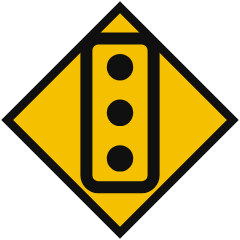
18. Why would this sign be installed on an approach?
Show answer
Answer B: Because the signal cannot be seen from far enough back for a driver to react in time
Advance notice of a signal is used where a crest, a curve, trees or a building keep the signal heads out of view until a driver is already too close to stop comfortably.
-
19. A deer crosses the road in front of you and disappears into the trees. What should you expect?
Show answer
Answer B: That other deer are likely to follow it across the very same stretch of road
Deer usually move in groups, so one crossing the road is a warning that more may follow.
-
20. You are driving on an open highway in a strong crosswind. What is the safest adjustment?
Show answer
Answer A: Reduce speed and keep a firm grip, expecting gusts on bridges and beside large vehicles
Gusts hit hardest in open gaps, on bridges and when passing high-sided vehicles, so a lower speed and a firm grip let you correct before you are pushed out of your lane.
-
21. What happens to the fine for a moving violation committed in an active Connecticut highway construction zone?
Show answer
Answer D: The court adds a fee equal to the whole original fine
The Superior Court adds a fee equivalent to one hundred percent of the fine for listed violations committed in a designated work zone.
-
22. How long is the administrative license suspension for a first Connecticut offense with a blood alcohol concentration of 0.08 or higher?
Show answer
Answer B: 45 days
The DMV imposes a 45-day suspension for a first elevated blood alcohol offense, and it begins 30 days after the arrest.
-
23. A bicyclist ahead of you extends the left arm out with the forearm bent upward. What does that signal mean?
Show answer
Answer A: The bicyclist intends to turn right
Bicyclists use the same hand signals as drivers: left arm straight out means left, left arm bent up means right, and left arm bent down means stop or slow.
-
24. What happens to the license of a Connecticut 16- or 17-year-old cited for breaking the teen driving restrictions?
Show answer
Answer A: The officer seizes it at once and it is suspended for 48 hours
The officer takes the license on the spot on behalf of the commissioner and it is suspended for 48 hours.
-
25. When should you turn on your signal before a turn or a lane change?
Show answer
Answer C: Well before the maneuver, so other drivers have time to react
A signal is a warning to others, so it has to be given far enough ahead of the maneuver that drivers and pedestrians can adjust.