
Connecticut DMV Permit Practice Test 6
Test 6 of 10. Pick an answer for each question to see if it is right and why; your score appears at the end. You need 20 correct answers to pass, the same ratio as the real Connecticut test.

- Questions25
- Correct to pass20
- Passing score80%
- Minimum age16 years
-
1. How many hours of practice driving must a Connecticut teen complete before the road test?
Show answer
Answer C: 40 hours
Both the school route and the home training route require 40 hours of practice driving.
-
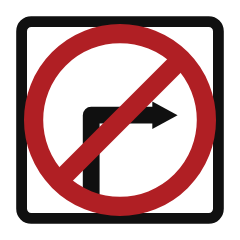
2. A driver stopped at a red signal wants to turn right and this sign is posted at the corner. What is permitted?
Show answer
Answer A: Nothing: the turn is barred whether the signal is red or green
The restriction works independently of the signal, so the usual permission to turn right after stopping at a red light does not exist where this sign is posted.
-
3. What seat belt rule applies specifically when a 16- or 17-year-old holds the Connecticut driver's license?
Show answer
Answer A: Every occupant must use a permanently installed seat belt
Connecticut's teen driver restrictions require every person in the vehicle to use a permanently installed seat belt.
-
4. What is the fine for a first distracted driving offense in Connecticut?
Show answer
Answer C: 200 dollars
Connecticut charges 200 dollars for a first distracted driving violation, and the fine rises for later offenses.
-
5. The vehicle you want to pass is traveling close to the speed limit. What should you do?
Show answer
Answer C: Stay behind, because a pass may not take you over the limit
The speed limit applies while passing too. If you cannot complete the pass without exceeding it, do not start the pass.
-
6. What fine does Connecticut set for driving a car still carrying a dangerous load of snow or ice?
Show answer
Answer B: 75 dollars
A noncommercial driver is fined 75 dollars for the infraction even when nothing actually falls from the vehicle.
-
7. Your road ends at a T-intersection with no signs or signals. Who has the right-of-way?
Show answer
Answer A: Traffic on the through road, and you must yield before entering
A driver on a road that ends at a T-intersection must yield to traffic on the through road that continues past the junction.
-
8. You arrive at an intersection where the traffic signals are completely dark after a power failure. What should you do?
Show answer
Answer A: Treat the intersection as an all-way stop and take turns
When a signal is dark or out of order, drivers on every approach must stop and proceed in turn, exactly as at a four-way stop.
-
9. What is the largest number of points Connecticut may assess for a speeding conviction?
Show answer
Answer A: One
The point system statute caps the assessment for a speeding conviction, allowing no more than one point.
-
10. How much of the prison sentence for a second Connecticut driving-under-the-influence conviction within ten years cannot be suspended?
Show answer
Answer C: One hundred twenty consecutive days
A second conviction inside ten years carries up to two years, of which one hundred twenty consecutive days may not be suspended or reduced.
-
11. What fine does Connecticut set for operating a registered vehicle without the required insurance?
Show answer
Answer B: 100 to 1,000 dollars
The offense carries a wide statutory fine range, and a commercial registrant who does it knowingly commits a felony.
-
12. Which speeding conviction makes the Connecticut operator retraining program mandatory rather than discretionary?
Show answer
Answer D: Driving more than 75 miles per hour
The commissioner must send any driver convicted of traveling above 75 miles per hour to the retraining program.
-
13. A funeral procession with headlights on is crossing an intersection when your light turns green. What should you do?
Show answer
Answer A: Wait and let the whole procession go through
Most states let a funeral procession stay together once the lead vehicle has lawfully entered an intersection, and in every state you must yield to vehicles already in the intersection, so wait until the line has passed.
-
14. What is the best way to handle the radio, the music player and the climate controls on a trip?
Show answer
Answer B: Set them before you start driving and let a passenger handle changes
Fiddling with controls takes eyes and hands off the driving task. Setting them before you move and letting a passenger make later changes removes the distraction entirely.
-
15. You are entering a marked school zone during the posted hours. What should you do?
Show answer
Answer A: Slow to the school zone limit and watch for children
The school zone limit applies throughout the posted hours, whether or not you can see any children at that moment.
-
16. What must a new Connecticut applicant finish before the DMV will administer the learner's permit knowledge test?
Show answer
Answer A: A free online Connecticut Work Zone Safety Course
Connecticut asks every learner's permit applicant to complete the state's free online work zone safety course and hand the certificate in before the knowledge test.
-
17. What counts as a complete stop at a stop sign?
Show answer
Answer C: The wheels stop turning before the stop line
A legal stop means the vehicle is no longer moving, made at the stop line or before entering the crosswalk or intersection.
-
18. You know in advance that you will be drinking at an event. What is the most reliable plan?
Show answer
Answer A: Arrange a driver who will not drink, or another way home, before the event begins
A decision made before drinking is not affected by alcohol, while judging your own fitness afterward relies on the very ability alcohol impairs first.
-
19. How does Connecticut treat a passenger who smokes cannabis inside a moving vehicle?
Show answer
Answer D: It is a class D misdemeanor
Connecticut wrote separate offenses for the driver and for the passenger, and the passenger commits the lesser of the two misdemeanors.
-
20. The vehicle ahead of you has pulled out to pass a truck. May you follow it out and pass as well?
Show answer
Answer B: No, wait until it is done and judge the road for yourself
You cannot see past the vehicle ahead of you, and if it has to abort the pass there is nowhere for either of you to go.
-
21. You see an open curb space on the opposite side of a two-way street. What should you do?
Show answer
Answer B: Drive on, turn around, and come back on that side
You must park on the right, facing the direction of travel, so reaching a space on the other side means going around rather than crossing into it.
-
22. What should you avoid when a hostile driver pulls alongside you?
Show answer
Answer A: Making eye contact, or answering the gestures in any way at all
Any response, including a look, encourages an aggressive driver, so give none and let the vehicle go.
-
23. How can you keep space at the sides of your vehicle in heavy traffic?
Show answer
Answer D: Drive in the gaps between the other vehicles rather than beside them
Travelling in the open spaces rather than alongside others keeps a way out open on at least one side.
-
24. What must a Connecticut driver do when meeting an ice cream truck showing flashing red lights and an extended stop arm?
Show answer
Answer A: Stop at least ten feet away, then pass at no more than 5 mph and yield to pedestrians
Connecticut wrote a frozen dessert truck rule modelled on the school bus rule, with a stop, a crawl past and a duty to yield to anyone crossing.
-
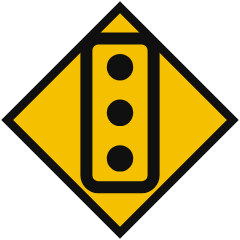
25. What does this sign require of the driver?
Show answer
Answer D: Reducing speed and being ready to stop at the intersection ahead
The advance notice asks the driver to slow and be ready to stop, while whether a stop is actually needed depends on the indication displayed on arrival.