
Connecticut DMV Permit Practice Test 3
Test 3 of 10. Pick an answer for each question to see if it is right and why; your score appears at the end. You need 20 correct answers to pass, the same ratio as the real Connecticut test.

- Questions25
- Correct to pass20
- Passing score80%
- Minimum age16 years
-
1. What is the highest speed limit Connecticut law lets the Office of the State Traffic Administration set on a multiple lane, limited access highway?
Show answer
Answer C: 65 mph
The statute caps the limit on a multiple lane, limited access highway at 65 miles per hour, and the office sets each highway's own figure within that cap.
-
2. A train has just passed a crossing that carries more than one set of tracks. What should you do?
Show answer
Answer B: Wait until the warning devices stop and you can see clearly along every track
A passing train can hide a second one coming on another track, so wait for the signals to clear and check each track before moving.
-
3. Is dictating a message by voice a safe alternative to typing one?
Show answer
Answer C: No, it still takes attention from driving
Composing and checking a spoken message loads the mind and usually pulls the eyes to the screen anyway, so research finds it no safer than other phone use.
-
4. During the first six months of holding a Connecticut driver's license, which passengers may a 16- or 17-year-old driver carry?
Show answer
Answer A: Only a licensed parent or guardian, a licensed driving instructor, or a qualified trainer at least 20 years old
For the first six months the only permitted passengers are a licensed parent or guardian, a licensed instructor, or an approved trainer who is at least 20 years old.
-
5. Under Connecticut law, what does exceeding a posted speed limit establish on its face?
Show answer
Answer A: That the speed was not reasonable for the conditions
Speed above an established limit is prima facie evidence that the speed was unreasonable, and staying under the limit is no defense when a hazard exists.
-
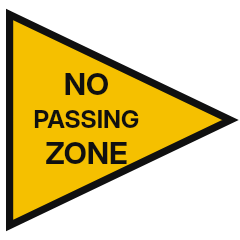
6. Where does the restriction that starts at this sign come to an end?
Show answer
Answer D: Where the centerline markings show that overtaking is allowed again
The sign marks the start of the restricted section, and the centerline markings along the road show how far it runs and where overtaking becomes lawful again.
-
7. Roughly how far does a vehicle travel at 55 mph during the few seconds a driver spends reading a text message?
Show answer
Answer D: About the length of a football field
Sending or reading a message takes the eyes off the road for about five seconds, which at 55 mph covers roughly the length of a football field with nobody watching the road.
-
8. You are about to open your door after parking on the traffic side of the street. What should you do first?
Show answer
Answer C: Check the mirror and look back for approaching vehicles and bicyclists before opening the door
A door opened into traffic can strike a passing bicyclist or vehicle, so you check behind you first and keep the door open no longer than necessary.
-
9. What does Connecticut require when a child under 16 rides in the open bed of a light pickup truck?
Show answer
Answer A: A properly adjusted and fastened safety belt for that child
A child under 16 may ride in an open bed only when belted, with narrow exceptions for authorized parades, farming use and autumn hayrides.
-
10. How many hours of classroom-type instruction does Connecticut require of a teen trained at home by a qualified trainer?
Show answer
Answer B: 22 hours
Home training calls for 22 hours of classroom-type instruction plus the separate eight-hour safe driving practices course.
-
11. A Connecticut driver picks up a second moving violation during the retraining monitoring period. How long is the suspension?
Show answer
Answer B: 60 days
During the 36-month monitoring period the suspensions run 30 days for a first violation, 60 for a second and 90 for a third or later one.
-
12. What does a yield sign require of a driver?
Show answer
Answer A: Slow down, and stop when necessary, so conflicting traffic can go first
A yield sign obliges the driver to reduce to a speed suited to conditions and to stop when needed so that conflicting traffic or pedestrians are not interfered with.
-
13. The gates at a railroad crossing begin to come down as you approach. What must you do?
Show answer
Answer A: Stop and wait until the gates are fully raised and the lights stop flashing
Once the gates start down you must stop clear of the tracks and wait until they are fully raised and the warning lights have stopped.
-
14. How does higher speed affect the outcome of a crash?
Show answer
Answer A: It leaves less time to react and greatly increases the force of impact
Speed shortens the time available to avoid a hazard and raises the energy released in an impact, so both the likelihood and the severity of a crash increase.
-
15. You realize your tires are running on ice. Which set of inputs is safest?
Show answer
Answer C: Gentle steering, no sudden braking, and no sudden acceleration
Whatever grip is left is used up at once by any sudden input, so every movement of wheel, brake and accelerator must be slow and small.
-
16. What is the purpose of a wide solid white line painted straight across your lane on the approach to an intersection?
Show answer
Answer C: It shows the point where a required stop must be made
A stop line indicates the point at which the stop required by a signal or a stop sign is to be made, ahead of the crosswalk and the intersection.
-
17. What does Connecticut law allow a driver aged 18 or older to do with a phone while driving?
Show answer
Answer A: Use it only with a hands-free accessory
Adult drivers may use a phone only through a hands-free accessory; holding the device is illegal even at a stop light.
-
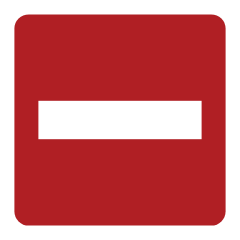
18. A driver hunting for an on-ramp meets this sign at the mouth of the pavement ahead. What is the correct action?
Show answer
Answer C: Keep out of that roadway and look for the proper approach elsewhere
The restriction is absolute and does not depend on how much traffic is present, so the driver has to reach the highway by an approach built for entering vehicles.
-
19. A regulatory sign posted at the start of a road reads LENGTH LIMIT 30 FEET. What does it control?
Show answer
Answer B: The overall length of vehicle allowed on that road
Some states post a length limit where tight curves or narrow structures lie ahead; it bars vehicles or combinations longer than the figure shown from using that road.
-
20. You are driving in the left lane at the posted speed limit and a line of vehicles has built up behind you. What should you do?
Show answer
Answer D: Move into a lane on your right when it is safe and let the traffic behind go by
Most states require traffic moving slower than the flow to keep right and reserve the left lane for passing, so a driver holding up a line of vehicles should move right when it is safe rather than block the lane.
-
21. What blood alcohol concentration makes a Connecticut driver under 21 legally intoxicated?
Show answer
Answer B: 0.02
Connecticut applies a 0.02 threshold to drivers under 21, far below the adult limit.
-
22. Which hand-held phone use does Connecticut allow an adult driver?
Show answer
Answer A: A call to a police department about an emergency
The narrow exception covers calls about an emergency to an emergency operator, a hospital or clinic, an ambulance company, a fire department or the police.
-
23. How long must a Connecticut applicant wait before retaking a failed road test?
Show answer
Answer C: 14 days
A failed road test may be repeated only after a minimum wait of 14 days.
-
24. You are parking facing downhill on a street with a curb. Which way should the front wheels point?
Show answer
Answer A: Toward the curb, so the vehicle would roll into it if it moved
Turning the wheels toward the curb when facing downhill means a vehicle that starts to roll is stopped by the curb instead of entering the traffic lane.
-
25. What does the Connecticut DMV charge for the testing package that covers the vision, knowledge and road tests?
Show answer
Answer C: 40 dollars
Connecticut charges a single 40 dollar testing fee that covers the vision test, the knowledge test and the road test.