
Connecticut DMV Permit Practice Test 8
Test 8 of 10. Pick an answer for each question to see if it is right and why; your score appears at the end. You need 20 correct answers to pass, the same ratio as the real Connecticut test.

- Questions25
- Correct to pass20
- Passing score80%
- Minimum age16 years
-
1. When may a newly licensed 16- or 17-year-old Connecticut driver begin carrying immediate family members such as siblings?
Show answer
Answer A: During the second six months of holding the license
Immediate family members are added to the approved passenger list only during the second six months of licensure.
-
2. May you park at the curb immediately next to a railroad crossing?
Show answer
Answer A: No, you must leave the crossing and its approach clear
Parking beside a crossing hides the tracks and the signals from approaching drivers and leaves no room for a vehicle that has to clear the rails.
-
3. A yellow diamond shows an arrow bent into a series of reversing turns. What does it warn about?
Show answer
Answer A: Three or more changes of direction close together
The winding road sign replaces a string of separate curve signs where several bends follow one another with only short straights between them.
-
4. You park in your own driveway and the rear of the vehicle sticks out over the sidewalk. What is wrong with that?
Show answer
Answer C: It blocks the sidewalk and forces people into the street
A vehicle overhanging the sidewalk pushes pedestrians, wheelchair users and strollers into the roadway, and blocking a sidewalk is prohibited.
-
5. How does a Connecticut teen recover a license seized for 48 hours after a restriction violation?
Show answer
Answer D: By appearing in person with a parent or guardian to sign for its return
No restoration fee is charged, but the teen and a parent or guardian must appear in person and sign an acknowledgment for the license.
-
6. How long is the suspension for a second conviction of operating without the required Connecticut insurance?
Show answer
Answer C: Six months
A second or later conviction brings a six-month suspension of both the registration and the license, against one month for the first.
-
7. What happens in Connecticut if insurance on a registered vehicle lapses for more than 14 days?
Show answer
Answer A: The DMV suspends the registration and charges a 200 dollar civil penalty
A lapse longer than 14 days leads to suspension of the registration and a 200 dollar uninsured motorist civil penalty for each lapse period.
-
8. Who qualifies as a trainer for a Connecticut learner's permit holder?
Show answer
Answer D: A person at least 20 years old who has been licensed for four consecutive years with no suspension
Connecticut defines a qualified trainer as someone at least 20 years old who has held a license for four consecutive years without a suspension.
-
9. Who may ride with a Connecticut learner's permit holder while that permit holder is driving?
Show answer
Answer D: Only a parent, a legal guardian or a qualified trainer
During the permit stage the only people allowed in the vehicle are a parent, a legal guardian or a qualified trainer.
-
10. What is the recommended minimum distance between the driver's breastbone and the center of the steering wheel air bag cover?
Show answer
Answer C: About 10 inches
An air bag inflates extremely fast, and keeping that much space lets it deploy fully before it reaches the driver, which is why the seat should be moved back as far as still allows comfortable control of the pedals.
-
11. When does Connecticut's snow and ice removal rule not apply to a driver?
Show answer
Answer A: When the snowfall began and carried on during the trip itself
The duty is lifted while snow, sleet or freezing rain is falling during the journey, and it does not apply while the vehicle is parked.
-
12. A sign reads REDUCED SPEED LIMIT AHEAD. What does it tell you?
Show answer
Answer D: A lower limit begins further along the road
The sign gives advance notice so a driver can slow gradually, and the new figure takes effect at the speed limit sign that follows.
-
13. An arrow panel in a work zone shows four flashing lamps in caution mode instead of an arrow. What does that display mean?
Show answer
Answer A: Warning only, so pass the work area with caution in your current lane
Caution mode gives a general warning without directing a lane change, so drivers stay alert and pass the activity with care.
-
14. What fine range applies to a first Connecticut driving-under-the-influence conviction?
Show answer
Answer B: 500 to 1,000 dollars
A first offense carries 500 to 1,000 dollars, a second 1,000 to 4,000 dollars and a third 2,000 to 8,000 dollars.
-
15. You are waiting to turn left at a solid green light with no green arrow. Oncoming traffic is approaching. What should you do?
Show answer
Answer A: Yield to the oncoming traffic and turn only when there is a safe gap
A solid green light permits the left turn but does not protect it, so you must yield to oncoming vehicles and to pedestrians before turning.
-
16. Which of these counts as an emergency vehicle under Connecticut's move over law when its lights are flashing?
Show answer
Answer D: A tow truck or a highway maintenance vehicle
The definition covers ambulances, fire and police vehicles and also maintenance vehicles and wreckers running with flashing lights.
-
17. The engine dies at speed and the dashboard lights go out on a dark road. What should you do?
Show answer
Answer C: Hold the wheel firmly, steer over to the shoulder and use the hazard lights
Never switch the ignition to lock, because the steering can lock; steer to the shoulder and warn traffic with the hazard lights.
-
18. The gates at a railroad crossing are down, and you can see that the road beyond them is clear. What is the correct action?
Show answer
Answer A: Wait until the gates rise completely and the lights go out
Lowered gates mean rail traffic is expected, and driving around them removes the only protection the crossing provides.
-
19. What is the fine for a first offense of passing a stopped Connecticut school bus that is showing flashing red lights?
Show answer
Answer B: 450 dollars
A first offense costs 450 dollars, while later offenses run from 500 to 1,000 dollars and can add jail time.
-
20. You have just had bad news and you feel very upset. What should you do?
Show answer
Answer B: Wait until you have calmed down, or else let somebody else drive
Strong emotion takes attention away from the road as surely as alcohol or fatigue, so it is a reason not to drive yet.
-
21. A driver's destination lies along the street to the right, and this sign stands at that corner. How should the driver reach it?
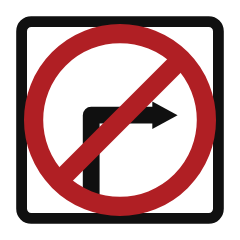
Show answer
Answer D: By going on and using a later intersection where turning is allowed
When a movement is barred at one corner the driver has to reroute, normally by continuing and coming back to the destination from a permitted approach.
-
22. A yellow diamond showing two vertical arrows, one pointing up and one pointing down, warns that
Show answer
Answer A: the road ahead carries traffic in both directions
The two-way traffic sign warns that the roadway ahead is not divided and that vehicles will be coming from the opposite direction.
-
23. What does a Connecticut police officer do immediately when a driver refuses the chemical test or fails it?
Show answer
Answer A: Takes the license and revokes the operating privilege for 24 hours
Acting for the commissioner, the officer seizes the license at the roadside and revokes the operating privilege for 24 hours.
-
24. Which sign tells you that the vehicles ahead are part of a funeral procession?
Show answer
Answer C: Headlights burning in daylight, with small flags or markers on the vehicles
Processions are normally identified by daytime headlights, hazard lights and flags or windshield markers, not by emergency lights or sirens.
-
25. You face a red light at an intersection that has no stop line and no marked crosswalk. Where must you stop?
Show answer
Answer C: Before entering the intersection
With no line and no crosswalk, the stopping point is the near edge of the intersecting roadway, close enough to see cross traffic but clear of it.