
Connecticut DMV Permit Practice Test 2
Test 2 of 10. Pick an answer for each question to see if it is right and why; your score appears at the end. You need 20 correct answers to pass, the same ratio as the real Connecticut test.

- Questions25
- Correct to pass20
- Passing score80%
- Minimum age16 years
-
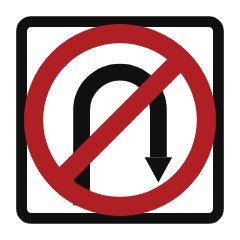
1. Why is this restriction used so often on a divided road just before a crest or a bend?
Show answer
Answer A: Because a vehicle turning across the median there stays hidden from approaching drivers until it is too late
The maneuver needs a long gap and good visibility, and where sight distance is short an approaching driver has no time to react to a vehicle turning across the road.
-
2. Your headlights suddenly go out while you are driving at night. What should you do?
Show answer
Answer A: Try the dimmer switch and the headlight switch, turn on the hazard lights and pull off the road
Switching between high and low beams or cycling the light switch sometimes restores the lights. If not, use the hazard and parking lights to get off the road safely.
-
3. A Connecticut driver under 18 is on a road posted below 65 mph. How far above the limit must that driver go to commit speeding under the youth provision?
Show answer
Answer C: More than 20 mph above
A driver under 18 commits speeding by exceeding a limit below 65 miles per hour by more than 20 miles per hour.
-
4. On a Connecticut two-lane road carrying traffic in opposite directions, what does the move over law require near a stopped emergency vehicle?
Show answer
Answer B: Reducing speed below the posted limit until safely past
Where there is no second lane in the same direction, the duty is to cut speed to a reasonable level below the limit until safely clear.
-
5. A vehicle coming toward you has drifted into your lane. What should you do?
Show answer
Answer D: Slow down, sound the horn, flash your lights and steer to the right if possible
Moving right gives the other driver space to recover and keeps you out of the lane they are most likely to return to. Braking reduces the force of any impact.
-
6. Besides darkness, when does Connecticut law require headlights to be lit?
Show answer
Answer B: During any precipitation, including snow, rain or fog
Lamps are required from half an hour after sunset to half an hour before sunrise, whenever people are not discernible at 500 feet, and during any precipitation.
-
7. What speed in a Connecticut highway work zone amounts to endangerment of a highway worker?
Show answer
Answer D: Fifteen miles per hour or more above the posted limit
Exceeding the posted work zone limit by fifteen miles per hour or more is one of the acts defined as endangerment of a highway worker.
-
8. A train has just cleared a crossing that carries two sets of tracks. What should you do?
Show answer
Answer B: Wait and look both ways for a second train
A passing train hides a second train on the other track, so wait until the signals stop and you can see that both tracks are clear.
-
9. What does Connecticut require of a driver passing an ordinary disabled car stopped on the shoulder of a multi-lane highway?
Show answer
Answer B: Moving over one lane when traveling in the adjacent lane, if that is safe
A later amendment extended the move over duty to stationary nonemergency vehicles on the shoulder, though without the speed reduction requirement.
-
10. How closely may a Connecticut driver follow an ambulance that is running with lights or siren?
Show answer
Answer A: No closer than 100 feet
The emergency vehicle statute bars following an ambulance running with lights or a siren more closely than 100 feet.
-
11. You are turning left from a divided highway through a median opening into a business on the other side. Who has the right of way?
Show answer
Answer C: The traffic on the roadway you are crossing
Turning through a median opening means crossing the opposite roadway, so you yield to all traffic on it before you go.
-
12. You want to turn left across the oncoming lane into a shopping center driveway. Who must you yield to?
Show answer
Answer B: Oncoming traffic and anyone using the sidewalk
A left turn into a driveway crosses both the oncoming lane and the sidewalk, so you give way to traffic and to pedestrians before completing it.
-
13. In a work zone one lane sits an inch or two lower than the lane beside it. How should you change lanes?
Show answer
Answer C: Slow down and cross the edge at a shallow angle, holding the wheel firmly
A vertical edge between lanes can catch a tire and jerk the steering. Crossing slowly at a shallow angle lets the wheel climb without grabbing.
-
14. You have stopped on the shoulder of a busy freeway with a flat tire that you cannot change safely. Where should you and your passengers wait?
Show answer
Answer A: Well away from the traffic side, behind a barrier or up the bank if there is one
People struck on the shoulder are a common cause of roadside deaths, so wait away from the traffic side and behind any barrier.
-
15. How can a Connecticut owner avoid a registration suspension after an insurance lapse notice?
Show answer
Answer D: By showing proof of coverage and paying a 200 dollar civil penalty
An owner who does not contest the finding may enter a consent agreement, produce evidence of insurance and pay the civil penalty instead of losing the registration.
-
16. What is the fine for a second distracted driving offense in Connecticut?
Show answer
Answer C: 375 dollars
Connecticut charges 200 dollars for a first offense, 375 dollars for a second and 625 dollars for a third or later one.
-
17. You arrive at an intersection with no signs, no signals and no markings at the same time as a vehicle on the road to your right. What must you do?
Show answer
Answer B: Yield to the vehicle on your right
At an uncontrolled intersection you must yield to a vehicle already in the intersection or approaching from your right.
-
18. What is the maximum fine when a Connecticut move over violation injures an occupant of an emergency vehicle?
Show answer
Answer C: 2,500 dollars
An ordinary violation is an infraction, but injuring an occupant of an emergency vehicle raises the fine to as much as 2,500 dollars, and a death raises it to 10,000 dollars.
-
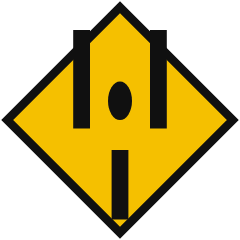
19. Beyond the point this sign refers to, which movement becomes unlawful?
Show answer
Answer D: Driving on the far side of the separation, against the flow
Once the two directions are separated, each roadway carries one-way traffic, so crossing to the other side means driving into oncoming vehicles.
-
20. Two roads come together at a shallow angle under a MERGE sign, with no yield line on either one. What is expected of you?
Show answer
Answer D: Adjust your speed and position so you blend smoothly into the other traffic
A merge means neither road ends at a stop; drivers adjust speed and position so that the two streams fit together without stopping.
-
21. You park a manual transmission car facing uphill at a curb. What is the correct combination?
Show answer
Answer A: First gear, wheels turned away from the curb, parking brake set
Facing uphill the car would roll back, so first gear resists that, the wheels turned out let a tire catch the curb, and the parking brake holds it.
-
22. A signal on an entrance ramp changes from red to green and lets one vehicle at a time onto the highway. What should you do?
Show answer
Answer A: Stop on the red and go on the green, one vehicle for each green
A ramp meter spaces vehicles out so they join the highway one at a time instead of arriving as a group, and it is a traffic signal like any other.
-
23. What is the most a vendor may charge for the Connecticut operator retraining program?
Show answer
Answer B: 85 dollars
The program vendor may charge up to 85 dollars, and the DMV does not collect that money itself.
-
24. What is the fine for a seat belt violation in Connecticut?
Show answer
Answer C: 92 dollars
The Connecticut Highway Safety Office lists 92 dollars as the current seat belt fine.
-
25. How does braking distance change if you double your speed?
Show answer
Answer D: It grows much more than twice as long
Braking distance increases with the square of speed, so doubling speed roughly quadruples the distance needed to stop.