
Connecticut DMV Permit Practice Test 10
Test 10 of 10. Pick an answer for each question to see if it is right and why; your score appears at the end. You need 20 correct answers to pass, the same ratio as the real Connecticut test.

- Questions25
- Correct to pass20
- Passing score80%
- Minimum age16 years
-
1. How far ahead of a Connecticut variable speed limit must the sign warning of the change stand?
Show answer
Answer C: Between 500 and 1,000 feet
The notice sign must stand not less than 500 feet and not more than 1,000 feet before the point where the variable limit begins.
-
2. What fine does Connecticut set for failing to carry the registration certificate and the insurance identification card in the vehicle?
Show answer
Answer B: 50 dollars
Both documents must be in the vehicle whenever it is driven on a public highway, and the statute fixes the fine at 50 dollars.
-
3. Alcohol is classified as which kind of drug?
Show answer
Answer B: A depressant that slows the central nervous system
As a depressant, alcohol slows the brain and nervous system, which lengthens reaction time and dulls the coordination that driving depends on.
-
4. Up to what age does Connecticut require a child to wear a helmet when riding a bicycle on the road?
Show answer
Answer C: 15 and under
The helmet duty covers children 15 and under on bicycles, scooters, skateboards and skates, and an officer may give the parent a verbal warning.
-
5. At a four-way stop another driver pulls out ahead of you when it was clearly your turn. What is the correct response?
Show answer
Answer B: Let that driver go through, then take your turn when the way is clear again
Right of way is something you give, never something you take, so yielding to a driver who takes it wrongly avoids a crash you would otherwise share.
-
6. What should you check on the hitch before towing a trailer?
Show answer
Answer B: That the coupler is locked and the safety chains are crossed underneath
The coupler must be latched and pinned, and the chains crossed under the tongue so they cradle it if the coupling lets go.
-
7. Another driver has pulled out to pass you. What should you do?
Show answer
Answer A: Stay in your lane, keep your speed steady or ease off, and let the pass finish
Accelerating while being passed forces the other driver to stay in the opposing lane longer, so the safe response is to hold or slightly reduce speed and stay right.
-
8. How should a long trip be broken up to keep the driver alert?
Show answer
Answer D: Stop for a break every couple of hours and share out the driving
Regular breaks and a change of driver are the only reliable answers to fatigue; caffeine only postpones it.
-
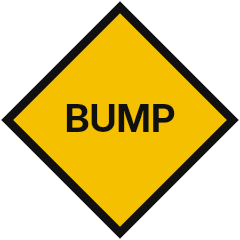
9. Why does this warning matter more on a motorcycle than in a car?
Show answer
Answer B: Because a sudden jolt can unsettle a two-wheeled machine and the rider can lose control
A jolt can push a motorcycle off line or lift a wheel, so a rider slows early, comes slightly off the seat and keeps a relaxed but firm hold on the handlebars.
-
10. After a crash your door will not open and you need to get out of the car. What should you try?
Show answer
Answer B: Try another door of the vehicle, or a window that will still open properly
A jammed door is common after an impact, and the simplest escape is a different door or a window rather than forcing the damaged one.
-
11. What follows in Connecticut when a driver cannot produce an insurance identification card during a stop?
Show answer
Answer A: It is treated as evidence on its face that the required coverage is missing
Failure to produce the card is prima facie evidence that the owner has not maintained the security the law requires.
-
12. A bicyclist stops at a four-way stop just before you do. Who goes first?
Show answer
Answer B: The bicyclist, who reached the intersection and stopped there before you did
A bicyclist on the roadway follows the same right of way rules as a driver, so arrival order decides the turn.
-
13. A Connecticut teen who trains at a commercial or secondary school driving program must hold the learner's permit for at least how long before the road test?
Show answer
Answer C: 120 days
Training through a commercial driving school or a secondary school program shortens the required permit period to 120 days.
-
14. You are behind a slow vehicle on a two-lane road and a marked passing lane begins a mile ahead. What is the sensible choice?
Show answer
Answer D: Wait for the passing lane rather than using the opposing lane
A passing lane lets you overtake without ever entering the lane used by oncoming traffic, which is far safer than a pass a minute earlier.
-
15. How does Connecticut classify drinking an alcoholic beverage while driving, even when the driver is not impaired?
Show answer
Answer D: A class C misdemeanor
Drinking while operating a motor vehicle is a separate crime in Connecticut, classed as a misdemeanor whatever the driver's blood alcohol level.
-
16. At what tread depth should a tire be replaced?
Show answer
Answer A: When the tread is worn down to 2/32 of an inch
At that depth a tire loses grip quickly, especially on wet roads, and the built in wear bars or the penny test both show when the point has been reached.
-
17. A Connecticut teen trained at home by a qualified trainer must hold the learner's permit for at least how long before the road test?
Show answer
Answer C: 180 days
Home training carries a longer permit period of 180 days than school-based training.
-
18. Besides its height, what else matters about a head restraint?
Show answer
Answer C: That it is close to the back of the head, and not far behind it
A restraint that sits far behind the head lets the head snap back before it is caught, so a small gap is important.
-
19. A driver who is passing you cannot complete the pass because a vehicle is coming. What should you do?
Show answer
Answer C: Ease off the accelerator and make room for them to drop back in
The only place for the passing vehicle to go is the gap behind you, and easing off opens that gap immediately.
-
20. A center lane is marked with a broken yellow line on each side and is controlled by overhead lane signals. How is that lane used?
Show answer
Answer A: It carries traffic one way or the other according to the signals
A reversible lane is marked with broken yellow lines on both sides and its direction of travel is set by the lane control signals above it.
-
21. What happens when tires are driven underinflated for a long time?
Show answer
Answer D: They wear at the edges, they run hot and they are more likely to fail
An underinflated tire flexes too much, which wears the shoulders and builds up heat that can destroy the tire.
-
22. Which reason allows a Connecticut 16- or 17-year-old driver to drive during the night curfew?
Show answer
Answer A: Travel for employment, school, religious activity, or medical necessity
The curfew has narrow exceptions for employment, school, religious activities and medical necessity, plus certain emergency responders.
-
23. What is Connecticut's minimum property damage liability coverage per accident?
Show answer
Answer D: 25,000 dollars
Connecticut requires at least 25,000 dollars of property damage liability coverage, a higher figure than many neighboring states.
-
24. How many alcoholic drinks does it take to begin affecting driving ability?
Show answer
Answer C: Even one drink can affect it
A single drink can slow reactions and weaken judgment before you feel any change. Impairment starts long before a person feels drunk.
-
25. What extra charge applies when a Connecticut driver renews a license that has already expired?
Show answer
Answer B: 25 dollars
Connecticut adds a late fee of 25 dollars to the renewal of an expired driver's license.