
Connecticut DMV Permit Practice Test 1
Test 1 of 10. Pick an answer for each question to see if it is right and why; your score appears at the end. You need 20 correct answers to pass, the same ratio as the real Connecticut test.

- Questions25
- Correct to pass20
- Passing score80%
- Minimum age16 years
-
1. What does black ice usually look like from the driver seat?
Show answer
Answer C: A patch of pavement that simply looks wet or slightly glossy
Black ice is clear, so you see the dark road through it and read it as a wet patch. In freezing weather, treat any wet looking patch as ice.
-
2. After a first Connecticut offense, how long must a driver who refused the chemical alcohol test use an ignition interlock device?
Show answer
Answer D: One year
A first refusal brings the same 45-day suspension as a failed test but a longer interlock period of one year, against six months for failing a 0.08 test.
-
3. Which classroom course must most Connecticut applicants aged 18 or older complete before the road test?
Show answer
Answer D: An eight-hour Safe Driving Practices Course at a licensed driving school
Adults must complete a Safe Driving Practices Course of eight hours at a licensed driving school, with narrow exemptions for previously licensed drivers.
-
4. At what speed does Connecticut law turn a speeding case into reckless driving on its own?
Show answer
Answer C: Above 85 mph
Operating above 85 miles per hour is by itself a violation of the reckless driving statute, whatever the posted limit is.
-
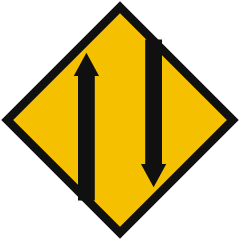
5. Which action becomes clearly more risky beyond this sign?
Show answer
Answer A: Using the left side of the roadway to overtake
With vehicles coming the other way on the same pavement, overtaking on the left needs enough clear road to pull out, pass and return, which is often not available.
-
6. You are driving on a road covered with a layer of wet fallen leaves. What should you expect?
Show answer
Answer B: As little grip as on ice, plus hidden markings and hidden holes
Wet leaves are as slippery as ice and they hide the lane lines and any potholes underneath, so slow well before curves and stops.
-
7. Why should you not rest your foot on the brake pedal as you drive?
Show answer
Answer D: The brake lights stay on and the drivers behind cannot read you
Resting on the pedal keeps the brake lights lit and wears the brakes, so following drivers stop believing your brake lights.
-
8. A driver behind you on a two-lane road clearly wants to pass. Why should you not wave that driver past?
Show answer
Answer B: You cannot see the whole road ahead for them and they may rely on your signal
Waving another driver out invites them to trust your judgment of a road you cannot see well enough, and the decision to pass belongs to the driver making it.
-
9. How long must a Connecticut driver under 21 keep an ignition interlock device after a first failed chemical test?
Show answer
Answer B: One year
The interlock schedule for drivers under 21 starts at one year for a first suspension and climbs from there.
-
10. What minimum bodily injury coverage does Connecticut require for an accident that injures more than one person?
Show answer
Answer B: 50,000 dollars
The financial responsibility limits are 25,000 dollars for one injured person and at least 50,000 dollars when more than one person is hurt in the same crash.
-
11. What is the main function of the guide sign series?
Show answer
Answer D: To identify routes and lead road users to their destinations
Guide signs identify routes, name destinations and give distances, so drivers can navigate without stopping to consult a map.
-
12. You are on a two-lane road where a broken yellow line runs on your side of the center. What does that pattern allow?
Show answer
Answer C: Passing when the way ahead is clear and it is otherwise legal
A broken yellow center line marks a stretch where passing is permitted for traffic on that side when it can be completed safely.
-
13. You are traveling at the same speed as a vehicle in the next lane, just behind its rear door. What should you do?
Show answer
Answer B: Change your speed so that you leave that driver's blind spot
That position is the classic blind spot. Slow slightly or move ahead so the other driver can see you before deciding to change lanes.
-
14. Why is following distance measured in seconds rather than in car lengths?
Show answer
Answer A: Because a time gap automatically grows with speed, while a fixed number of car lengths does not
A gap counted in seconds keeps the same margin of reaction time at any speed, whereas a fixed number of car lengths becomes far too small as speed rises.
-
15. A Connecticut driver aged 21 or over fails the chemical test for the first time. How long must an ignition interlock device stay fitted?
Show answer
Answer B: Six months
A first failed test at age 21 or over brings a 45-day suspension followed by six months of ignition interlock use.
-
16. Where is passing prohibited even when no line is visible?
Show answer
Answer D: On a curve or near the crest of a hill, at intersections and at railroad crossings
Passing is prohibited wherever your view of oncoming traffic is blocked or where vehicles may cross your path, which includes hills, curves, intersections and rail crossings.
-
17. Why should you dim the instrument panel and keep interior lights off when driving at night?
Show answer
Answer C: Bright light inside the vehicle reduces your ability to see the dark road ahead
Your eyes adapt to the brightest light they see. A bright cabin keeps them from adjusting to the darkness outside and creates reflections on the windshield.
-
18. A freeway sign shows a minimum speed limit. What does it require?
Show answer
Answer B: That you keep up with it unless conditions make that unsafe
A minimum speed limit keeps very slow vehicles off the highway, but weather, traffic or a mechanical problem may make a lower speed necessary and lawful.
-
19. Does Connecticut's hand-held phone ban apply while a driver waits at a red light?
Show answer
Answer A: Yes, because a vehicle held up by traffic or a signal is still being operated
The statute defines operating a motor vehicle to include being temporarily stationary because of traffic, road conditions or a traffic control signal.
-
20. You have a green light and are turning right while people are crossing the street you want to enter. Who goes first?
Show answer
Answer B: The pedestrians, and you wait until they are clear of your path
A green light permits the turn but does not remove the duty to yield to pedestrians already crossing the street you are turning into.
-
21. At highway speed, a large object suddenly appears in your lane and there is open space beside you. Which response is often the most effective?
Show answer
Answer B: Steer around it, since at speed you can often turn quicker than you can stop
Above roughly 25 mph, stopping distance is long while a lane change takes only a moment. When space is available, a controlled steer around the hazard avoids the impact.
-
22. What is Connecticut's minimum bodily injury liability coverage for one person injured in a crash?
Show answer
Answer C: 25,000 dollars
Connecticut requires at least 25,000 dollars of bodily injury liability coverage per injured person.
-
23. How long must a Connecticut applicant aged 18 or older hold the learner's permit before taking the road test?
Show answer
Answer C: 90 days
An adult applicant must hold the permit for at least 90 days unless an exemption such as military service or earlier licensed driving applies.
-
24. Besides the limits on who may ride, what other passenger rule binds a Connecticut driver aged 16 or 17?
Show answer
Answer D: The number of passengers may not exceed the seat belts permanently installed
A 16- or 17-year-old license holder may not carry more passengers than the vehicle has permanently installed seat safety belts.
-
25. What does Connecticut law require a licensee to do at every other license renewal?
Show answer
Answer D: Watch a state safety video on laws affecting motorists, pedestrians and cyclists
State law directs the commissioner to require the licensee to watch a safety video on current road laws at every other renewal.