
Connecticut DMV Permit Practice Test 7
Test 7 of 10. Pick an answer for each question to see if it is right and why; your score appears at the end. You need 20 correct answers to pass, the same ratio as the real Connecticut test.

- Questions25
- Correct to pass20
- Passing score80%
- Minimum age16 years
-
1. What night driving curfew applies to Connecticut drivers aged 16 and 17?
Show answer
Answer B: 11 p.m. to 5 a.m.
Drivers aged 16 and 17 may not drive between 11 p.m. and 5 a.m. except for the reasons the law allows.
-
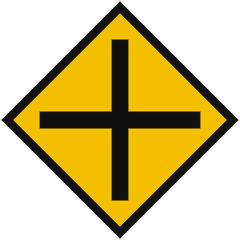
2. What should a driver expect a short distance beyond this sign?
Show answer
Answer C: Another road crossing the one being traveled
Traffic may enter or cross from either side at the intersection ahead, so the driver should ease off, cover the brake and check both approaches.
-
3. You are towing a loaded trailer for the first time. How should you drive?
Show answer
Answer A: Slow earlier and keep a longer following gap
A trailer adds weight and length, so stopping takes longer and every maneuver needs more room and more warning.
-
4. You are traveling at 55 mph and see a vehicle ahead moving at about 15 mph. What is the hazard?
Show answer
Answer A: You reach it far sooner than you expect
At a 40 mph difference you cover the gap in a few seconds, which is why drivers strike slow vehicles they saw in plenty of time.
-
5. Which vehicle may a licensed Connecticut driver aged 16 or 17 never operate?
Show answer
Answer D: A vehicle requiring a public passenger endorsement, or a vanpool vehicle
The teen restrictions bar these drivers from any vehicle that requires a public passenger endorsement and from vanpool vehicles.
-
6. You are approaching a horse and rider on a country road. What about your horn?
Show answer
Answer C: Do not sound it at all, because the noise can frighten the animal
A startled horse is dangerous to its rider and to you, so pass wide and slow and leave the horn alone.
-
7. Does this sign settle who has the right-of-way at the intersection ahead?
Show answer
Answer D: No, it only gives notice of the intersection; the control there decides priority
A warning prepares the driver for what is coming but grants no priority, so whatever stop control, yield control, signal or right-of-way rule applies at the intersection is what decides.
-
8. What blood alcohol concentration makes a Connecticut driver aged 21 or older legally intoxicated?
Show answer
Answer C: 0.08
Connecticut treats 0.08 or higher as legal intoxication for drivers aged 21 and older.
-
9. What is the minimum age to apply for a Connecticut learner's permit?
Show answer
Answer C: 16
Connecticut sets 16 as the legal age for both a learner's permit and a driver's license.
-
10. What does Connecticut charge to restore a license or registration after a suspension?
Show answer
Answer C: 175 dollars
The DMV charges a 175 dollar restoration fee for most suspension types before driving privileges return.
-
11. How many correct answers are needed to pass the Connecticut knowledge test?
Show answer
Answer C: 20
An applicant must answer at least 20 of the 25 questions correctly, which is 80 percent.
-
12. Your light turns green, but a vehicle is still in the middle of the intersection. What should you do?
Show answer
Answer D: Wait until the intersection is clear before you move ahead
A green light means go only when the way is clear. Drivers already inside the intersection must be allowed to finish crossing.
-
13. What renewal option does Connecticut offer a driver who is at least 65 years old?
Show answer
Answer A: A shorter two-year license at a reduced fee
A driver who is at least 65 on the day of the request may choose a two-year license for 24 dollars instead of the standard longer term.
-
14. You park on level ground in a lot. Where should the front wheels be pointing?
Show answer
Answer C: Straight ahead, so the car would not veer if it moved
On the level the wheels go straight so that the car stays in its own space, and so that a shunt from behind does not send it across a lane.
-
15. Where is this sign installed in relation to the hazard it announces?

Show answer
Answer A: Far enough before the hazard that a driver can slow down and stop short of it
This is an advance warning sign, placed on the approach so a driver has time to react before reaching a crossing that a curve or a crest may be hiding.
-
16. Which Connecticut driver aged 16 or 17 is exempt from the passenger limits and the night curfew?
Show answer
Answer D: One who is a volunteer firefighter or ambulance member answering an emergency
Active volunteer fire, ambulance and emergency medical members responding to or returning from a call are exempt, as are assigned Safe Ride drivers.
-
17. Beside an accessible parking space there is an area painted with diagonal stripes. What is it for?
Show answer
Answer C: It is an access aisle for wheelchairs and lifts, and no vehicle may park or stop in it
The striped access aisle gives the room a ramp or lift needs to deploy, so blocking it makes the adjacent accessible space unusable.
-
18. What does Connecticut charge to renew a driver's license for an eight-year term?
Show answer
Answer C: 96 dollars
An eight-year renewal costs 96 dollars, while a six-year renewal costs 72 dollars.
-
19. Your exit from a three-lane highway is about a mile ahead on the right, and you are in the left lane. What should you do?
Show answer
Answer B: Start moving right now, one lane at a time
Plan ahead and change lanes one at a time well before the exit, so you never have to cut across several lanes at the gore.
-
20. What is the fine for a third or later distracted driving offense in Connecticut?
Show answer
Answer C: 625 dollars
Connecticut sets the fine at 200 dollars for a first offense, 375 dollars for a second, and 625 dollars for a third or later offense.
-
21. A yellow diamond showing a bicycle is posted on a rural road. What should a driver expect?
Show answer
Answer A: Bicyclists crossing or riding along the roadway there
The bicycle warning sign is used where a bikeway crosses the road or where riders are likely to be in the traffic lanes, so drivers should look carefully and pass wide.
-
22. What share of a Connecticut distracted driving fine goes back to the town whose officer issued the summons?
Show answer
Answer B: 25 percent
The state remits 25 percent of the fine to the municipality that issued the summons, certified quarter by quarter.
-
23. You have a green left-turn arrow but a pedestrian is still walking in the crosswalk you must cross. What should you do?
Show answer
Answer B: Wait until the crosswalk is clear before turning
A green arrow protects you from other vehicles, but it never removes the duty to yield to a person already in the crosswalk.
-
24. Which statement best describes what the basic speed law requires of you?
Show answer
Answer C: That you never drive faster than is reasonable and safe for the conditions
Nearly every state has a basic speed law that makes the conditions the real limit: weather, traffic, light and road surface can all require a speed well below the posted number.
-
25. How often should you check your mirrors while driving?
Show answer
Answer C: Every few seconds, so you always know what is around you
Traffic behind and beside you changes constantly. Frequent, brief mirror checks keep a picture of your surroundings current so nothing surprises you.