
Connecticut DMV Motorcycle Practice Test 59
- Questions16
- Correct to pass13
- Passing score81%
- Minimum age16 years
-
1. A speed limit sign carries a second panel reading TRUCKS 55. What does that panel do?
Show answer
Answer B: It sets a lower legal limit for trucks
A truck speed limit panel is regulatory, so trucks are bound by the lower figure while other traffic keeps to the main limit.
-
2. A yellow diamond on an exit ramp shows a truck tipping over onto two wheels. Which drivers does it concern most?
Show answer
Answer D: Those in tall vehicles carrying a high load
The truck rollover sign warns that the curve can overturn a vehicle with a high center of gravity, so such drivers must slow well below the normal ramp speed.
-
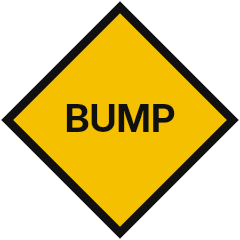
3. How should a driver respond to this sign?
Show answer
Answer C: Slow down before reaching the rough spot and cross it at a steady, low speed
Losing speed before a sharp rise in the pavement keeps the vehicle settled, while braking or accelerating on top of it unsettles the suspension and costs grip.
-
4. A city transit bus ahead of you has stopped at the curb with its passenger door open. What does the law require of you?
Show answer
Answer D: Nothing special, but pass slowly and watch for people
The mandatory stop applies to a school bus showing red flashing lights, not to a transit bus, though a careful driver still slows for crossing passengers.
-
5. The handlebars begin to shake violently in a wobble at speed. What is the correct response?
Show answer
Answer C: Grip the bars firmly and close the throttle gradually, without braking
Braking or accelerating during a wobble usually makes it worse, so the rider holds on, rolls off gradually, and pulls off the road to find the cause.
-
6. Your passenger has ridden on other people's motorcycles before. What should you do before setting off?
Show answer
Answer A: Brief them anyway, because your machine and your instructions differ
Handholds, footrests, exhaust position and the signals a rider uses all vary from machine to machine, so every passenger is briefed on the machine they are about to ride on.
-
7. At the scene of a crash you were part of, what are you required to do besides stopping?
Show answer
Answer B: Give your name, your address and vehicle details, and help anyone who is hurt
Every state requires drivers involved in a crash to identify themselves and to render reasonable aid to anyone injured.
-
8. At an intersection that uses a lagging left turn, when is the left-turn arrow displayed?
Show answer
Answer B: After the through movement has run
A lagging left turn phase runs at the end of the green rather than the start, so a driver waiting to turn should not assume the arrow has been missed.
-
9. A center lane is bordered by a solid yellow line on the outside and a broken yellow line on the inside, with turn arrows painted inside it. What is that lane for?
Show answer
Answer C: Left turns made by traffic traveling in either direction
That marking pattern identifies a two-way left-turn lane, which drivers approaching from both directions may use to prepare for a left turn.
-
10. How much room should a rider try to leave when passing a line of parked cars?
Show answer
Answer A: Enough to clear an opening door, roughly the width of a car door
A door swings out about the width of a door, so ride at least that far from parked vehicles and slow down wherever you cannot leave that much space.
-
11. What does Connecticut law require before a person under 18 may drive on a public highway?
Show answer
Answer A: The vehicle must be insured for the state financial responsibility amounts
No one under 18 may drive, and no one may let such a person drive, unless the vehicle carries the insurance amounts the financial responsibility statute sets.
-
12. At a stop sign with a painted stop line and a crosswalk, where must you stop?
Show answer
Answer D: At the stop line, before it and before the crosswalk
You stop at the stop line first, and only if there is no stop line do you stop before the crosswalk, and only if there is neither do you stop before entering the intersection.
-
13. A sign at the intersection prohibits U-turns, but the opening looks wide and clear. What may you do?
Show answer
Answer B: Obey the sign and turn around somewhere else
A prohibition applies whatever the traffic looks like at that moment, usually because of sight distance or conflicts you cannot see from the lane.
-
14. There is a stop sign but no stop line and no crosswalk. Where must you stop?
Show answer
Answer A: Before entering the intersection, where you can see cross traffic
With no line or crosswalk, stop before you enter the intersection at the point where you can see traffic on the cross street.
-
15. The light turns yellow when your front wheels are already past the stop line inside the intersection. What should you do?
Show answer
Answer B: Keep going and clear the intersection without speeding up
Once you are legally in the intersection the safest and correct action is to continue through and clear it, without accelerating.
-
16. You realize at the last moment that you have passed the street where you meant to turn. What should you do?
Show answer
Answer D: Keep going and turn around where it is safe and legal
A missed turn is a minor inconvenience; braking suddenly, backing up or turning across traffic to recover it causes crashes.