
Connecticut DMV Motorcycle Practice Test 19
- Questions16
- Correct to pass13
- Passing score81%
- Minimum age16 years
-
1. How should a group decide how often to stop for fuel?
Show answer
Answer A: By the range of the machine with the smallest fuel tank
Planning around the smallest tank keeps the group from splitting up when one rider has to leave the route to look for fuel.
-
2. A person using a wheelchair is waiting to cross at a corner ahead. How should you treat that person?
Show answer
Answer B: As a pedestrian with the right of way at the crossing
A wheelchair or a mobility scooter user has the rights of a pedestrian, so yield the whole crossing and wait until the crossing is finished.
-
3. Where should you be looking as you steer through a turn?
Show answer
Answer C: Toward the point on the new road where you want to end up
Drivers steer toward what they look at, so looking through the turn to where you want to go keeps the path smooth and accurate.
-
4. Why is it dangerous to make a left turn from the second lane from the center?
Show answer
Answer C: Because a driver in the lane beside you is turning into the same space
Drivers in the proper turn lane are entitled to that space, and turning across them puts two vehicles into one path through the intersection.
-
5. What is the correct body position for riding over a bump or an obstacle?
Show answer
Answer B: Rise slightly off the seat with your weight on the footrests, absorbing the shock with knees and elbows
Coming slightly off the seat lets your legs and arms work as extra suspension instead of transferring the impact through your body and the handlebars.
-
6. You must cross tracks or pavement seams that run in nearly the same direction as your path of travel. What should you do?
Show answer
Answer C: Move far enough away to cross at an angle of at least 45 degrees, then turn sharply across
A shallow crossing lets the groove catch and steer the front wheel, so the rider sets up to cross at 45 degrees or more and makes one deliberate turn across it.
-
7. The signal ahead turns yellow while you are approaching it. What does the yellow light mean?
Show answer
Answer C: The red is coming; stop if you can do so safely
A steady yellow warns that the red is next. Stop if you can do so safely; enter the intersection only when stopping would be dangerous.
-
8. Your right-turn lane shows a green arrow while the through lanes face a red ball. What does that mean?
Show answer
Answer C: Only the right turn is allowed, and it is protected while the arrow lasts
A green arrow gives a protected movement in that direction only; the red ball still stops the through traffic in the other lanes.
-
9. On a highway with mileage-based exit numbering, you have just passed exit 42 and are looking for exit 55. About how far is it?
Show answer
Answer B: Thirteen miles
With mileage-based numbering each exit takes the number of the nearest milepost, so subtracting one exit number from another gives the distance in miles.
-
10. Why is a shoulder check especially important on a road with motorcycles and bicycles?
Show answer
Answer D: A narrow vehicle can disappear completely in the blind spot
A motorcycle or a bicycle is small enough to be hidden entirely by a door pillar or by the blind spot the mirrors do not cover.
-
11. An arrow panel at a work zone displays a flashing arrow pointing to the left. What does it require?
Show answer
Answer C: Move out of the closed lane into the lane on the left
A flashing or sequential arrow on an arrow panel directs traffic out of a closed lane and into the lane the arrow points to.
-
12. An oncoming car is waiting to turn left across your path at an intersection. What is the safest response?
Show answer
Answer D: Slow, cover the brakes and pick a lane position that keeps an escape path
A car turning left in front of a rider is one of the most common motorcycle collisions, so the rider prepares to stop or swerve rather than trusting the driver to wait.
-
13. Traffic is heavy and crawling where a sign warns that your lane ends and two lanes must become one. What is the best practice?
Show answer
Answer C: Use the lane to the end, then take turns merging one by one
In stop-and-go traffic the zipper merge, using both lanes up to the merge point and then alternating, keeps the queue shorter and traffic moving; in free-flowing traffic move over as soon as it is safe.
-
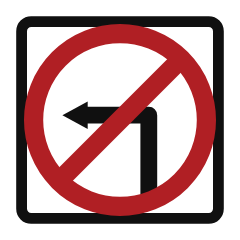
14. No plaque stating days or hours accompanies this sign at the intersection. When does the restriction apply?
Show answer
Answer D: At all times, since nothing limits it to particular periods
A regulatory restriction runs continuously unless a supplemental plaque states the days or hours during which it applies.
-
15. Besides phones, which items count as mobile electronic devices under Connecticut's distracted driving law?
Show answer
Answer A: Laptops, gaming systems, digital video players and digital cameras
Connecticut defines mobile electronic devices broadly to include laptops, gaming systems, digital video players and digital cameras.
-
16. In heavy stop-and-go traffic, why does using both lanes right up to a merge point help?
Show answer
Answer D: It stores the queue in two lanes, so the backup is shorter
Filling both lanes halves the length of the queue and keeps it away from the traffic upstream, which is why alternating at the merge point works better when traffic is slow.